Showing posts with label sewing. Show all posts

Monday, June 6, 2011

Unraveling thread confusion

Q. I'm so confused! What kind of thread should I use for sewing a skirt?
A. Here are four of the most common kinds of threads you'll see and where to use them:
All-purpose = Use for general sewing.
Best – Polyester. Use this for your skirt. Since it’s made from long, staple fibers, polyester is strong, durable and colorfast. Brands: Mettler, Gutermann.
Okay – Cotton-covered polyester. Because it is wrapped, it can shred and break. But it's less expensive and has more color choices. Brand: Coats and Clark. Don’t buy "bargains." Throw away old spools.
Cotton – Use for quilting. Not pre-shrunk so if it’s used in clothing, the seams will pucker in the first wash.
Rayon – Use for decorative stitching such as embroidery and serging. Not strong enough for general sewing.
Silk– High sheen and high-priced. Use for couture sewing.

Tuesday, February 15, 2011

Making a wedding dress.


Q. The sister of a good friend of mine is getting married, and wants to have me make her wedding dress. Since I have never really done this before, I'm not quite sure where to start. She's on a tight budget. Fortunately, the 2 styles that we picked out for the dress are not complicated. The basic structure is a v-neck (possibly sweetheart neckline) tea-length dress with straps, maybe bias cut, maybe with princess seams. The major requirement is that she doesn't want it made of polyester or another synthetic material. So we'll be looking at silks, silk-hemp blends, maybe silk-linen. I sure would love your advice.

A. To keep to her budget, let's start by keeping the cost of fabrics, trims and notions below $100. The two of you should search through the bridal/evening gown section of the Vogue pattern book. Choose the pattern size based on her body measurements for bust, primarily, then waist and hip. Look for the body measurements chart in any American pattern book — they are standard.
Stay away from silk hemp or silk linen. They're more expensive and wrinkle. Go to silk dupioni instead. It’s typically less expensive and easier to sew. Be sure to serge/zigzag the edges to prevent raveling. Stay away from silk charmeuse or silk satin unless you are experienced. It's more expensive too.
Josephines and Fabric Depot have nice silks. But you'll get a better price on the silks at Mill End-Milwaukee. Use your JoAnns coupon to get 25% off your Mill End purchase. Buy an extra yard or two just in case.
Plan for two fittings: One in muslin because you are likely to alter the pattern. One in fashion fabric. Leave one-inch side seams just in case. Add a contingency clause (extra $50) for a second muslin fitting in case there are major changes. The rest goes to your time (cutting, sewing, fitting, consulting, alterations). If you can keep your work to under 20 hours, you can make money.
Want to know more about starting and running an apparel business? Then look for our apparel business classes on www.portlandsewing.com. The next round start in April.
Good luck -- Sharon@portlandsewing.com


Saturday, January 1, 2011

Cute dog gets new duds


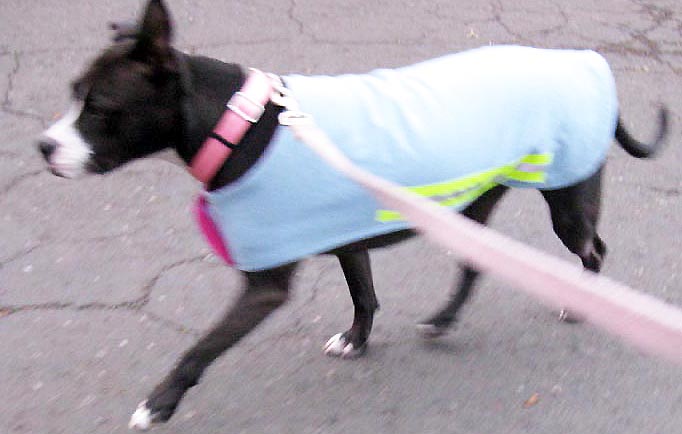
Deeg the dog proudly shows off one of her two new dog coats during a recent walk in the park.
Owner Hyun Joo Kim had just finished the Beginning Sewing 3 class when she decided to take on this project. With its mix of camouflage cotton and polar fleece, it was a bit trickier than the fabric Kim used for her Beginning 3 project. And then, there was the issue of fitting a pattern to a dog.
“While I made a lot of mistakes, [the second one] came really better looking and it fit my dog. I am very pleased.”
Kim admits that the Boston terrier-pitbull mix “is the love of my life.”
If you could ask Deeg, we bet she would say the same about Kim. She’s so toasty now in her new coat, that even on a cold December day, she can take a moment to stop and smell the roses.
Kim plans to take patterning, draping and more sewing class in 2011.


Thursday, January 15, 2009

INVESTING IN INDUSTRIAL SEWING MACHINES


Visited Joe Payne at Portland’s Rooster Roc SewCo last Saturday.  You know, the store at 3427 NE 72nd Ave. behind Annie’s Donuts on Sandy?  The building with the big “Commercial Sewing Machines” sign on it?
           I love that place and I don’t know why.  Car showrooms?  Make my skin crawl.  Hardware stores?  Ho-hum.
           But put me in a sewing machine store and this girl drools!  Maybe it’s the thought of all that power sewing.  6,600 stitches per minute.  That’s fast, baby.  Who wants a Jaguar when you can have a Juki?  Yeah, that’s why – I need the speed.
         What does a sewing girl need in her sewing room?  Take a note and send a memo to the men and partners in your life.  The holidays are over but you must have another gift-giving occasion soon, right?
I have 13 machines.  Six of them are industrials.  Three of them are key:
       - Single needle lockstitch.  Mine is the Juki DDL8700.  It has an on-board computer.  This means it automatically backstitches, cuts the thread and lifts the presser foot with a kick of my heel on the footplate.  I can program it to sew the same length seams quickly and automatically.
Don’t need all these bells and whistles?  You can get a Juki DDL8300 – a standard for sewing contractors – for one-fourth the price of mine.
- 3-thread overlock (i.e., serger).  You need this for knits so get a pack of ballpoint needles.  Mine is the Juki MO3304.  The MO6704 has since replaced it.
I also have 5-thread safety stitch for simultaneously stitching and finishing the seams of pants, jackets, blouses.  It’s a Juki MO6716.  Of all the machines, this is the one I use the most.  But if your budget makes you choose, go with the 3-thread.  It’s more versatile.
- Blindhemmer.  Mine’s a Consew.  If you’re using the blindhem foot on your home sewing machine, stop!  The Consew is how it’s done in the real world of apparel.  You can set the length and depth so no stitches show on the outside.
Yes, other than the Consew, all my machines are Jukis.  Brother, Pfaff and Singer Union Special make fine machines.  I just trust the Jukis.
Yes, I bought all my machines new.  The action is smooth.  The machines, problem free.
Yes, I bought almost all my machines from Joe.  You can buy off the Internet, just be sure that:
- It comes with a power table.  This is the secret behind the speed.  These are 20”x48”, so make sure you have the room.
- Shipping is free.  The motor is very heavy.  Better yet, make sure someone can deliver and set it up for you.  You’re going to have plugs, a “fanbelt” and an oil pan that needs the right kind of oil.  You need someone who knows how these go together.
- Made in Japan, not China.  More reliable.
Commercial machines can be confusing.  So many models!  And I like to give them a test drive.  That’s why I shop at Joe’s.
I’ve known Joe since I came to Portland and he sold me a home sewing machine, the Pfaff 1471.  He worked at Montavilla Sewing before the fire and the new store they built at SE 84th and Stark.
Montavilla sold industrial machines back then.  His job was to sell and repair them.
From what I can gather, Joe retired.  Montavilla quit selling industrials.  So Joe took up the trade and moved it to NE Portland.
         The name Rooster Roc?  Well, he lives near there in Corbett, Ore.  At least I think.  You see, Joe knows a lot about machines but he’s not a big talker.  When he answers the phone, listen closely.  The words he blurts out?  “Sewing machines.”

NOTE:  My little company, PortlandSewing, will offer industrial machine sewing classes in April so stay tuned.  Want to be notified when classes come up?  Send me an e-mail.

Cheers -- Sharon

Wednesday, January 14, 2009

FREELANCE AND CONTRACTORS

TIMES ARE TOUGH.  Folks can't find jobs.  Apparel companies are laying off designers.
As a result, a few of my students are going freelance.  But they are nervous about what to do and how to make sure they get paid.  This is something most design schools don't seem to teach.  So I thought I'd share with you what I've been telling them.
Have a written contract.  My lawyer husband says there are 3 elements to make a contract.  But Sam, one of my business teachers, hammered in my head the five C's of contracts.  Here's how he defined them:
1) Consent.  A mutual understanding of what the contract covers.  E.g., we are talking about a dress.
2) Creation, or offer and acceptance.  E.g., I am going to make this dress in this picture for this person.  You are going to give me money.
3) Consideration, or an exchange of something of value.  E.g., for delivering this dress on May 3, 2009, you are going to pay $1,000.
4) Completion.  The dress is delivered on time and the check cleared the bank.
5) Competence.  Basically, don't sign a contact with anyone younger than 18 or of doubtful reputation.
Now here are some details.  Contracts can cover many subjects, but mine all have these things in common:
- The names and titles of the principals in the contract:  The client and the contractor (you!).
- A specific description of the item/work to be done.
- The deliverables.  E.g., illustrations could be hard copy on a specific paper, pdfs of a certain resolution and a disc of said pdfs in a specific format.  Deliverables can come from the client as well as the contractor.
- Date when the deliverables are due.  This should be done in increments at natural progress points, e.g., sketches, draft illustrations for approval, final illustrations.
- The payment.  This often is done on the same dates that the deliverables are due with increments and totals given in $numbers and percentages.  BTW, save your receipts and time logs!
- Signatures of the principals, along with the titles and date of signature.
You may also be asked to sign a non-disclosure agreement.  This just means you won't blab about your client's work.  One page is enough.  Go on the web to see what such agreements look like.
Bear in mind that most clients want to hear how much a project will cost in total.  They don't want to hear a price/hour with the number of hours left open.
Creating such an estimate is tough at first.  With luck, you've tracked your hours in doing similar projects for yourself or school.
Don't expect more than minimum wage ($8.40/hr in Oregon) if you don't have the tools or good skills.  But if you are experienced, just new, charge $20/hr.  Go up as your client list grows.  If you can sew a custom-sized lined skirt with zipper, hem and waistband in two hours, you should charge at least $50/hr.  Thus your bid for such a project would be $100 -- for the sewing only.  Illustrating?  Patterning?  Consulting about designs and fabrics?  Fitting the client once or twice in a muslin?  Your price goes up depending on the number of hours you allot for these activities.
Oh, and BTW, if you get a client who says the project is very simple and straightforward but can't give details, don't do it.  If s/he starts changing her/his mind, drop 'em.  If it's a wedding dress and she starts bringing her bridezilla mom, drop her.  If it's a friend/relative, set the stage, give a written estimate with options on the number of fittings/drafts and get money up front when you sign the contract.  Then send invoices and exchange money at each deliverable point.
Be brave.  Be professional.  Believe that your time and skills are worth something.

I'd love to hear your experiences in freelance.  Send them in! -- Sharon Blair, studioskb.com and portland sewing.com

NOTE:  My friend, Laura, from Nike and I plan to offer apparel business classes Spring 2009.  Stay tuned!

Saturday, December 27, 2008

Want to buy a sewing machine? Here some advice.

Meg Okies at Opal here in Portland sent me an e-mail.  She says, "I have a friend in the market for a sewing machine.  Given your experience with local dealers, I thought you might be able to offer a recommendation. . ."

I think Meg asked me because I have 14 machines.  Yes!  I'm not ashamed to admit it.  No!  I don't want a 12-step program.  All I want is another machine.  I've tried them all -- home sewing and industrials.

Since many of you have holiday cash and may be in the market for a machine, here's what I told Meg:
- For basic sewing on a budget, look at the Janome DC 3018.  All the main stitches including 3 nice-looking buttonholes with an easy-to-use foot.  And you can get one for about $300.
- If you eventually want to go into heirloom sewing, check out the Vikings.  Nobody has more interesting stitches and sewing feet.
- If you eventually want to go the embroidery route, check out the Babylocks.  They also have the same buttonhole foot at the Janome.
- If you want to sew apparel, check out the Pfaffs.  Don't bother with the entry level machines; pay a little more for the ones with the built-in walking foot (IDT).  Warning:  the buttonholes suck.
- Berninas also have an excellent automatic buttonholer on their upper level machines.  But I've found them to be pricey to buy, add accessories or get repaired.
All these machines are fine for quilting.
- Don't waste your time on Singer, White, Brother or EuroPro.  There's a good reason whey these brands are so cheap.  You'll spend more time fighting and fixing your machine than you will in sewing.

Where should you go to buy a machine?  Montavilla Sewing.  They have locations in Gresham and Beaverton.  Their main store is at SE 84th and Stark.  Many of you know I have taught classes at Montavilla.  But I didn't buy my first machine there.  After I shopped around, I found Gary Campbell at Montavilla.  Thanks to him, I buy most of my machines now at Montavilla.

Yes, Gary is a salesman but he's also straight-talking, knows the machines and will give you a deal.  Jason, Linda, Bill and Brett (the guy who owns Montavilla) are great too.

Montavilla gives free sewing machine lessons with purchase and has classes (including my new Fashion Design class).  They have great service too.

Go to Common Thread off I-5 south for a Bernina.

Should you buy a machine from a website?  Of course!  Just make sure it has the operators manual and all the attachments, including a foot pedal and power cord.  But know that there will likely be no warranty.  The transfer kills it.  But you can buy a service agreement from Montavilla.  Craig's List is your best bet.  Take your project or at least your favorite fabric and test the machine before buying.  A pair of jeans that need hemming make an excellent test!

Should you buy a machine from a big box or department store or HSN/QVC or "Singer School Machine" ads?  I'd say "no."  You're buying it from people who know nothing about it, can't service it and won't help you if you have a problem.  The warranty usually is useless.  Everyone I know who has gone this route has regretted it and immediately traded their machine for one of the ones I mentioned above.

Where should you buy an industrial machine?  I'll save that for another post.

What have been you experiences with sewing machine or buying/servicing a machine?  Let me know.  I'd love to hear it!

Until then, happy sewing!
Sharon K. Blair
portlandsewing.com